When someone robbed me my labtop last year, I thought I was going to loose my identity. I didn't backup my ressources...because I am so clever.
So now I keep my external memory bar and my usb keys always with me....
Thursday, January 18, 2007

“FaceBook stalking”

"Facebook stalking" is the term that has developed for this typically harmless practice of finding people (or finding their profiles, at least) on Facebook and learning about them without their knowledge or consent. "It's a lot easier than the real thing," said freshman Abe Del Rio. Facebook stalking is mostly harmless and used to find out someone's e-mail to coordinate a class project or to discover other people on campus with common interests and tastes.
But it isn't just students that are Facebook stalking anymore. Campus security and residence life staffs have begun using pictures posted on the social networking site to find and prosecute students for alcohol violations. At Western Washington University, four students were placed on probation and one was asked to leave the housing system based on alcohol violations that were documented and discovered through Facebook.Privacy pollution, the modern freedom robbery

The expression “privacy pollution” refers to a diary problem we all know: the "junk" mails and the spams. We all receive every day newletters about the new technologies to enlarge our penis...
You see? That's it.
What are some of the concerns?
E-mail spam is the most common form of internet spamming. It involves sending unsolicited commercial messages to many recipients. Unlike legitimate commercial e-mail, spam is generally sent without the explicit permission of the recipients, and frequently contains various tricks to bypass e-mail filtering.
Spammers obtain e-mail addresses by a number of means: harvesting addresses from Usenet postings, DNS listings, or Web pages; guessing common names at known domains (known as a dictionary attack); and "e-pending" or searching for e-mail addresses corresponding to specific persons, such as residents in an area. Many spammers utilize programs called web spiders to find e-mail addresses on web pages (see also address munging). Many e-mail spammers go to great lengths to conceal the origin of their messages. They might do this by spoofing e-mail addresses (similar to Internet protocol spoofing). The spammer will modify the e-mail message so it looks like it is coming from another e-mail address. However, many spammers make it easy for recipients to identify their messages as spam by placing an ad phrase in the From field. Spammers try to circumvent the email filters by intentionally misspelling common spam filter trigger words.
For example, "viagra" might become "vaigra", or other symbols may be inserted into the word as in "v/i/a/g./r/a". E-mail service providers have begun to use the misspellings themselves as a filtering test. The most dedicated spammers—often those making a great deal of money or engaged in illegal activities, such as the pornography, casinos and Nigerian scam businesses—are often one step ahead of the providers. Retail e-mail services are updated constantly with improved spam filters, keeping track of spammers' technological progress by examining e-mails their users report as spam (many providers today have a prominent button to report spam). So-called "spambots" are a major producer of e-mail spam. The worst spammers create e-mail viruses that render an unprotected PC a "zombie computer"; the zombie will inform a central unit of its existence, and the central unit will command the "zombie" to send a low volume of spam. This allows spammers to send high volumes of e-mail without being caught by their ISPs or being tracked down by antispammers; a low volume of spam is instead sent from many locations simultaneously.
Bill Gates, speaking at the World Economic Forum in Davos in January 2004, predicted that spam would soon be "a thing of the past", and that Microsoft was working on several temporary solutions, as well as on a permanent "magic solution", to spam.
The California legislature found that spam cost United States organizations alone more than $10 billion in 2004, including lost productivity and the additional equipment, software, and manpower needed to combat the problem.
Spam's direct effects include the consumption of computer and network resources, and the cost in human time and attention of dismissing unwanted messages. In addition, spam has costs stemming from the kinds of spam messages sent, from the ways spammers send them, and from the arms race between spammers and those who try to stop or control spam. In addition, there are the opportunity cost of those who forgo the use of spam-afflicted systems. There are the direct costs, as well as the indirect costs borne by the victims - both those related to the spamming itself, and to other crimes that usually accompany it, such as financial theft, identity theft, data and intellectual property theft, virus and other malware infection, child pornography, fraud, and deceptive marketing.
It is complicated to fight it because spamming itself abridges the historical freedom of the Internet, by attempting to force users to carry the costs of material which they would not choose.But there are actions, as I will explain it here.
An ongoing concern expressed by parties such as the Electronic Frontier Foundation and the ACLU has to do with so-called "stealth blocking", a term for ISPs employing aggressive spam blocking without their users' knowledge.
These groups' concern is that ISPs or technicians seeking to reduce spam-related costs may select tools which (either through error or design) also block non-spam e-mail from sites seen as "spam-friendly". SPEWS is a common target of these criticisms. Few object to the existence of these tools; it is their use in filtering the mail of users who are not informed of their use which draws fire. Some see spam-blocking tools as a threat to free expression—and laws against spamming as an untoward precedent for regulation or taxation of e-mail and the Internet at large. Even though it is possible in some jurisdictions to treat some spam as unlawful merely by applying existing laws against trespass and conversion, some laws specifically targeting spam have been proposed.
In 2004, United States passed the Can Spam Act of 2003 which provided ISPs with tools to combat spam. This act allowed Yahoo! to successfully sue Eric Head, reportedly one of the biggest spammers in the world, who settled the lawsuit for several thousand U.S. dollars in June 2004.
Examples of effective anti-abuse laws that respect free speech rights include those in the U.S. against unsolicited faxes and phone calls, and those in Australia and a few U.S. states against spam. In November 2004, Lycos Europe released a screensaver called make LOVE not SPAM which made Distributed Denial of Service attacks on the spammers themselves. It met with a large amount of controversy and the initiative ended in December 2004.Court cases Attorney Laurence Canter was disbarred by the Supreme Court of Tennessee in 1997 for sending prodigious amounts of spam advertising his immigration law practice. Robert Soloway lost a case in a federal court against the operator of a small Oklahoma-based Internet service provider who accused him of spamming. U.S. Judge Ralph G. Thompson granted a motion by plaintiff Robert Braver for a default judgment and permanent injunction against him. The judgment includes a statutory damages award of $10,075,000 under Oklahoma law. In the first successful case of its kind, Mr. Nigel Roberts from the Channel Islands won £270 against Media Logistics UK who sent junk e-mails to his personal account.
Thursday, January 11, 2007
Youtube personal pages implication

When you create a personal page on you tube, it can have a lot of implications. Why?
First of all, because you enter in a community which is uge because Youtube is incredibly popular. This makes you involved in the web life and in the activity you chose. For example, if you upload videos you will have a lot of contact in this sector and you will be free to creates new pages with others youtube guys.
You can also be implicated in the web economic life if someone have noticed you for your talents or originality. It involves too the question of artistic property. If your production is at a buzz start, you artistic or entertainment life will change.
For me, the best use of Youtube profile is the professional one.
I think it is really helpful when for example you have an association without financial suppport. It is the best advertisement in terms of rentability and exposition. You are sure to find a public. It is the same thing for young artists who can express themselves in this site without technical matters. I show you here what I mean by the way of an animation picture.
Even in the big companies, the e-cv is a good thing to see how the employees behave themselves behind new technologies. It is a new way to evaluate the candidate, who is more free to present himself with his own words. i think this is a good invention but not for everybody. There are people who are no used to be filmed. They could fill really ill at ease to present themselves in a professional way in front of a camera. For me it is important to respect this. We have to let people chose how he wants to present himself.
The results are amazing. There is an example of e-cv I found of You Tube.
Enjoy.
A definition of the web content management system

A content management system (CMS) is a computer software system used to assist its users in the process of content management. A CMS facilitates the organization, control, and publication of a large body of documents and other content, such as images and multimedia resources. A CMS often facilitates the collaborative creation of documents. A web content management system is a content management system with additional features to ease the tasks required to publish web content to Web sites.
We generally use it for storing, controlling, versioning, and publishing industry-specific documentation such as news articles, operators' manuals, technical manuals, sales guides, and marketing brochures. It may support the following features:
- Import and creation of documents and multimedia material
-Identification of all key users and their content management roles
- The ability to assign roles and responsibilities to different content categories or types.
- The definition of the content workflow tasks, often coupled with event messaging so that content managers are alerted to changes in content.
- The ability to track and manage multiple versions of a single instance of content.
- The ability to publish the content to a repository to support access to the content. Increasingly, the repository is an inherent part of the system, and incorporates enterprise search and retrieval.
For example, we use it right now on this blog. We made a wiki in my class where we also use CMS.
Thursday, November 09, 2006
What SHTTP means.
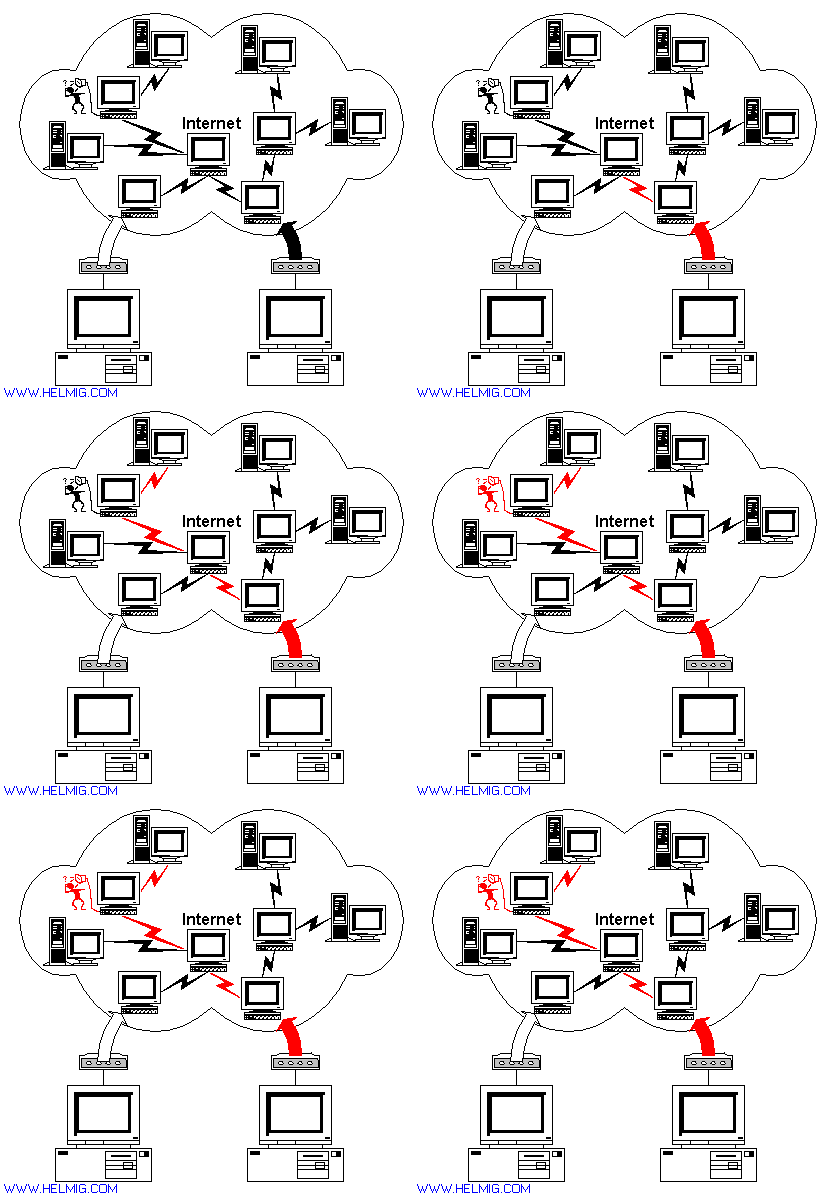
SHTTP means Secure Hypertext Transfer Protocol which is developed by Enterprise Integration Technologies in 1995 to ensure security with commercial transactions on the Internet. A protocol that provides secure transactions over the Web. It is endorsed by a variety of organizations. An extension to the HTTP protocol to support sending data securely over the World Wide Web. Not all Web browsers and servers support S-HTTP. Another technology for transmitting secure communications over the World Wide Web -- Secure Sockets Layer (SSL) -- is more prevalent. However, SSL and S-HTTP have very different designs and goals so it is possible to use the two protocols together. Whereas SSL is designed to establish a secure connection between two computers, S-HTTP is designed to send individual messages securely. Both protocols have been submitted to the Internet Engineering Task Force (IETF) for approval as a standard.
RSS

| What is RSS? | ||
| The Internet today contains a wealth of information. Avid Internet users visit many interesting websites and read many articles. Information and web pages make their way in to the favorite folder for later viewing. Over the course of time, re-visiting these bookmarks becomes a major task for users especially as the number of bookmarks grows. A better technique for users is to automatically receive information about updates to their favorite websites. Internet users can employ special software, like newsreaders and RSS-aggregators, to organize RSS feeds and get automatic updates. Products like Active Web Reader allow you to read RSS files. Such types of programs go beyond simply reading. They also organize RSS feeds, manage updates, monitor website changes and search for information online. They can keep you automatically updated on the latest changes by checking RSS feeds and displaying items from them. | ||
Let's talk about cybercrime.
According to Wikipedia, cybercrime is a term used broadly to describe criminal activity in which computers or networks are a tool, a target, or a place of criminal activity. These categories are not exclusive and many activities can be characterized as falling in one or more categories. Although the term cybercrime is usually restricted to describing criminal activity in which the computer or network is an essential part of the crime. This term is also used to include traditional crimes in which computers or networks are used to enalbe the illicit activity. Examples of cybercrime in which the computer or network is a tool of the criminal activity include spamming and certain intellectual property and criminal copyright crimes, particularly those facilitated through peer-to-peer networks.
Examples of cybercrime in which the computer or network is a target of criminal activity include unauthorized access (i.e, defeating access controls), malicious code, and denial-of-service attacks.
Examples of cybercrime in which the computer or network is a place of criminal activity include theft of service (in particular, telecom fraud) and certain financial frauds. Finally, examples of traditional crimes facilitated through the use of computers or networks include Nigerian 419 or other gullibility or social engineering frauds (e.g., "phishing"), identity theft, child pornography, online gambling, securities fraud, etc.
Cyberstalking is an example of a traditionl crime -- harrassment -- that has taken a new form when facilitated through computer networks. Additionally, certain other information crimes, including trade secret theft and economic espionage, are sometimes considered cybercrimes when computers or networks are involved.
Cybercrime in the context of national security may involve hacktivism (online activity intended to influence policy), traditional espionage, or information warfare and related activities. Another way to define cybercrime is simply as criminal activity involving the information technology infrastructure, including illegal access (unauthorized access), illegal interception (by technical means of non-public transmissions of computer data to, from or within a computer system), data interference (unauthorized damaging, deletion, deterioration, alteration or suppression of computer data), systems interference (interfering with the functioning of a computer system by inputting, transmitting, damaging, deleting, deteriorating, altering or suppressing computer data), misuse of devices, forgery (ID theft), and electronic fraud.
Here a the principal hackers of the time.
Apart from Tsutomu Shimomura, the other three hackers mentioned here were criminals at some point of time and for various reasons. They have all repented for their actions and are currently contributing in positive ways to the burgeoning cyber realm. It is interesting in retrospect to take note of when, why and how they turned to crime. Tsutomu, however, is recognized for bringing down Kevin Mitnick, arguably the most notorious hacker ever. The I-Love-You virus and the Sasser worm had caused so much damage without apparent human intervention that they too deserve due recognition.
Kevin Poulsen
Probably one of the most talented hackers of all time, Kevin Poulsen wanted more than what his high paid job could offer him. His crimes ranged from stealing classified military data to hacking into a radio station’s telephone lines in order to “win” a Porsche. He did not call himself the “Dark Dante” for nothing.
Kevin Mitnick
Well-known in the annals of the FBI, he was one of the most slippery crooks the bureau ever tried to apprehend. As proficient at actually committing the crime as he was at deceiving the authorities, he left a remarkable trail of crime as long as he was on the run. He had delved so deep into cybercrime that he was barred from using a computer for a long time after he was caught.
Adrian Lamo
This is the classic case of a white hacker who went too far.
Tsutomu Shimomura
A high profile researcher at
I love you Virus
This virus is notorious throughout the world. A highly effective self-replicating algorithm coupled with an instantly provocative message like “ Kindly check the attached LOVELETTER from
Sasser Worm
This malware does not even need a provocative message to have people loading it onto their computers – it comes and goes as it pleases. Being connected to the Internet is enough to get it loaded onto one’s computer and though it did not directly cause damage, it caused severe network disruptions worldwide leading to millions lost due to loss of productivity. Imagine the impact this had on hospitals and banks.
I would like to finish this presentation by one of the most important cybercrime story of the 20th. The american government called it "electronic Pearl Harbor".
For two days in January 1999, hackers repeatedly tapped into military computers at Kelly Air Force Base in
NBC News has learned the attack was a sophisticated, coordinated assault through computer networks in
The hackers didn't receive top secrets but the Pentagon's No. 2 man, Deputy Secretary of Defense John Hamre, says the
For the past several months, so-called cyberterrorists, operating from as many as 15 locations worldwide, have launched a series of coordinated attacks on Pentagon computers -- as many as 100 per day.
The attackers remain unidentified and since anyone with a computer is a potential enemy, experts warn the
Among the computers targeted were those of the Air Intelligence Agency, the Air Force Information Warfare Center and a Joint Chiefs of Staff command-and-control operation. Officials said it was the most sophisticated attack yet on Pentagon computers.
The attack so worried the Pentagon that it called in the FBI, which has launched a criminal investigation. 
Several experts said such an attack wouldn't have even been detected at all a few months ago but the government has been quietly setting up cyberwar early-warning operations at the Pentagon, CIA and the National Security Agency over the past year.
Without falling down the paranoïa, we all have to be careful. I have never been a victim of cybercrime but I am a possible target as all Internet users. In fact, as soon as we pay something on internet ,our bank code can be stolen.
However, the protection is making progress. Some sure systems are applied as Paypal for example, and work well.
Tuesday, November 07, 2006
Why Youtube is so great.
Today, nearly all Internet users know or have heard about Youtube. It is the symbol of the last innovation of the NTIC, the Web 2.0.
What is you Tube?
YouTube is a popular free video sharing web site which lets users upload, view, and sharevideo clips. Founded in February 2005 by three employees of PayPal, the San Bruno-based service utilizes Adobe Flash technology to display video. The wide variety of site content includes movie and TV clips and music videos, as well as amateur content such as videoblogging. It is staffed by 67 employees. In October 2006, Google, Inc., announced that it had reached a deal to acquire the company for $1.65 billion USD in Google's stock. The acquisition is expected to close in the fourth quarter of 2006.
The company's humble beginnings in a garage and commitment to offering free services necessitated outside financial backing. In November of 2005, venture capital firm Sequoia Capital invested an initial $3.5 million; additionally, Roelof Botha, partner of the firm and former CFO of PayPal, joined the YouTube board of directors. In April 2006, Sequoia put an additional $8 million into the company, which had experienced a boom of popularity and growth in just its first few months.
At present, YouTube is one of the fastest-growing websites on the World Wide Web, and is ranked as the 10th most popular website on Alexa, far outpacing even MySpace's growth. According to a July 16, 2006 survey, 100 million clips are viewed daily on YouTube, with an additional 65,000 new videos uploaded per 24 hours. The site has almost 20 million visitors each month, according to Nielsen/NetRatings, where around 44% are female, 56% male, and the 12- to 17-year-old age group is dominant. Youtube's pre-eminence in the online video market is staggering. According to the website Hitswise.com, Youtube commands up to 64% of the
The key of this success is, in my opinion, the speed of download and the fact it is free. Everyone can use it, even if he or she's not a king of the internet. We can explain this success by the buzz it had created when it started. Youtube has revealed people, who are famous in the website
community. As an example, I will present the lonelygirl15 phenomenon.
Lonelygirl15 is a fictional video blog that came to international attention via YouTube, a popular video sharing website. The central character is a YouTube user of the same name, although she is commonly known as Bree. The character achieved massive popularity with her series of videos, which acquired over 15 million cumulative views. But after viewers grew suspicious, lonelygirl15 was exposed as a fictitious character played by
The series, which began June 16, 2006 is still running, with new videos appearing regularly.The series, which began June 16, 2006 is still running, with new videos appearing regularly.
As far as I am concerned, I use Youtube everyday. I only watch videos, like musical clips and series. I don't donwload movies, that it why I don't share what I watch. I don't like to download because when I do it I feel like robbing something. I don't feel at ease. One of the reason why I like Youtube is that it is now allowed. Must of all, it is not necessary to download because we can see what we want, when we want and wherever there is an internet access. It is so much faster and safer that download sites like Emule or Napster, that it would be silly to not use it.
Thinking about the possible uses of Youtube in the future, we can all imagine. The best like the worst.
We can plan that people suffering of censorship will find here a way to get out of their silence. They have the public to read their message. We can also dream that some friendships and love stories will born. I think that it is already the case but I am sure that this movement will grow.
But stop dreaming, and let think about professional uses. Managers now have the possibility to edit methodology, secret of success or informations they want to transmit to their employees. When we see that the White House uses Youtube in her campaign against drugs, we can easily apply this to the company system. Youtube is as all the medias a way of pressure. Here comes the bad aspect. We know that all the files coming to Youtube are checked. But if the company, now forming part Google, is on lobbying, the game will be ended.
Thursday, October 26, 2006
comprehension of each others
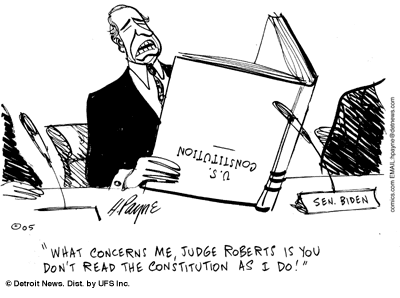
Comprehension exists when people have the choice of the subject they are going to speak about. Internet permits that because we don't have to connect us.
We can find a lot of sites on Internet where we can find people who understand our questions, especially when there are "secrete" ones. As the success of women solidarity shows, we can always find someone who is in the same situation. There are some relevant examples concerning the comportement problems. When you have a problem, you go on a forum and there so many people in the same situation in the world that you are sure to find a help.
Insight, outside

Insigth is the human quality which can be helpfull to avoid mistakes. However, it is sometimes necessary to express its feelings and fears. For example, Internet, with solidarity forums, has saved a lot of women in oppressing situations, in particular in arabean countries. They had no rights and they couldn't express their pain. Internet permitted them to feel less loneliness and to keep the hope to see an arrangement of their situation.
Patience is the key word of the succes

Patience is necessary in all life and especially with technologies. When your computer is too slow, your washing machine is going crazy during your husband is asking what you will do for dinner, you have to be patient to stay in good tems with your nerves. A good example of patience on Internet is the web assistance. There are some forums where people is here to answer to your questions. They never let you down even if you ask silly questions.
Discipline on Internet

A good example of discipline on the Internet that we all have to respect concerns the online classes. There are a lot of today and they work really well. We have to focus on the subject and accept the rules as like as a traditional class. Interent is one of the worst place of temptation today because we can find all we want. So we need discipline to follow one objective. None is there, next to us, to say what we have to do; we have to find the solutions on our own. I really like the aspect of Internet which responsabilize people and make them more independant.
Internet: a place for the development of human qualities.

The six qualities of good professional and, more generally, social activity are generosity, patience, discipline, perseverance, insight and comprehension.
A perfect example of generosity on the e-culture today is the websites of peer to peer as You Tube and Daily Motion. When someone gets a video on Internet, quite long to download, he immediately puts it on the website. There are some people who became famous in the “download” word because they put the videos very early and they traduce it. I think it is a good state of mind which strengthens the links between people.
Wednesday, October 25, 2006
social networks
After having seen one the juridical dimension of the Internet, I will observe one its social aspects through social networks. A social network is a social structure made of nodes which are generally individuals or organizations. It indicates the ways in which they are connected through various social familiarities ranging from casual acquaintance to close familial bonds. The term was first coined in 1954 by J.A.Barnes (in: Class and Committees in a Norwegian Island Parish, "Human Relations"). The maximum size of social networks tends to be around 150 people and the average size around 124 (Hill and Dunbar, 2002). Social networking also refers to a category of Internet applications to help connect friends, business partners, or other individuals together using a variety of tools. Social network theory views social relationships in terms of nodes and ties. Nodes are the individual actors within the networks, and ties are the relationships between the actors. There can be many kinds of ties between the nodes. In its most simple form, a social network is a map of all of the relevant ties between the nodes being studied. Msn Messenger is an online social network and it is really popular.


What is DRM?
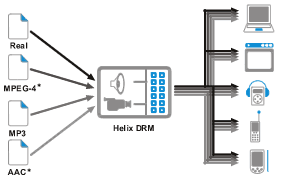
What is DRM?
DRM vendors and publishers coined the term digital rights management to refer to the types of technical measures discussed here, applying it only to digital media (and analog media that has been released in digital form). There is a long history of objection on the part of copyright holders (often music distributors or broadcasting companies) to copying technology of any kind. Examples have included player piano rolls (early in the 20th century), audio tape recording (after WWII), video tape recording (eg, in the famous Betamax case in the
In order to complete this definition, I am going to present the digital Millennium Copyright Act, its actors and its implications.The Digital Millennium Copyright Act (DMCA) is a United States copiright law passed unanimously on May 14, 1998, that criminalizes the production and dissemination of technology that allows users to circumvent copyright protection methods, rendering all forms of DRM-stripping and circumvention software illegal.
The arrest of Russian programmer Dimitry Sklyarov in 2001, for alleged infringement of the DMCA, was a highly publicized example of the law's use in preventing the further development of anti-DRM measures. While working for Elcomsoft, he developed The Advanced eBook Processor, an application that allowed authorized users to strip usage restriction information from protected e-books. Sklyarov was arrested in the
The DRM has a certain influence in recordings and video.
web neutrality
What I want to debate now is the emergence of web neutrality. The expression « Web neutrality » involves the influence of lobbying companies in the success of some websites. The issues which are discussed to save the internet are the abolition of the Internet’s first amendment. This amendment created in 2003 was based on what site pays the most. I think it is unfair of course, as all the monopoles. It shows that the time of the utopia of the Internet as the most democratic media, like Mac Luhan described in the last seventies is finished. It is a market like the others with its lobbies and its own regulations. That is why the project of web neutrality is a good on. It have to be a priority on these days because we all have to protect the freedom of information and communication.
Poscasting God...

I will focus on one exemple: the godcasting. The main godcast networks linked on Wikipedia are: Disciples with microphones, God's iPod, The godcast Network.
This example shows that this new technology affects all social activities, entering in our life. The web is forming part of our society and it is built like a state, with politic and economical laws.
Thursday, October 19, 2006
News about podcast

The first subject I want to discuss on this blog dedicated to the NTIC is the podcast phenomenon.
First of all, I will try to give you a complete definition of the podcasting, its uses and its influence.
Podcasting, according to Wikipedia, is “the practice of making audio files available online in a way that allows software to automatically detect new files and download them.” Technically this is accomplished using RSS feeds to provide information about a collection of audio files in MP3 format. Podcasting lets anybody with a microphone; a computer and an Internet connection publish audio broadcasts that can be listened to by people anywhere in the world. Because the barriers to entry are very low, podcasting is rapidly becoming a popular way for people share audio broadcasts. Podcasts are free and can be automatically downloaded to portable media players, so they can be listened to whenever it’s convenient.
There are already many types of podcast available including:
-Audio books with chapters broadcast in installments.
-Music shows for all the latest new music directly to your PC.
-News broadcasts to ensure you keep up to date with what’s happening.
-Entertainment broadcasts automatically delivered on a regular basis.
-Businesses keeping customers informed about latest products and developments.
-Sports news - keeping fans updated with their team’s progress and achievements. -Religious leaders can even provide a service to their local community with important messages, sermons and pastoral news.
The term podcasting is often used to refer to one off audio broadcasts that can be downloaded from the Internet although this is not, strictly speaking, a true podcast which should be a ‘series’ of broadcasts. It is not a streaming to listen music or to watch a video like Youtube or Daily motion.
The word is a “portmanteau” of Apple’s “Ipod” and broadcasting.
It seems to be the most important development in e-communications in the last six months. There are so many activities using it, like radio, Politics, Education and Religion. We heard of it more than Web 2.0 because of it’s simple use and it’s low cost.
Subscribe to:
Posts (Atom)